



Start with a clear picture — the Averyn Record Vault
A navigator-led engagement to gather, request, and organize your family's records; establish access; and deliver a portable, shareable record bundle plus a plain-English summary.
The Record Vault is designed to be a tangible, portable asset — useful even if you don't continue with ongoing support.
Deposit applies to the $999 Vault fee. Non-clinical administrative coordination.
How it works
Three steps — start with one, add what you need.

Record Vault pricing
A fixed-scope, one-time engagement. Vault work begins only after the Vault fee is paid in full.
Averyn Record VaultIncludes the full Vault package for one Supported Person. Reservation deposit of $199 applies to the total.
- $199 reservation deposit — reserves your start date; applies to the Vault fee
- Remaining $800 — auto-charged before kickoff
- Vault work begins only after full payment clears
Prefer to talk first? Book a 15-min intro call.
What your household receives
The Record Vault produces a portable, shareable record bundle plus an administrative, plain-English summary. Everything is designed so a new physician, ER team, or second opinion can quickly review the picture.
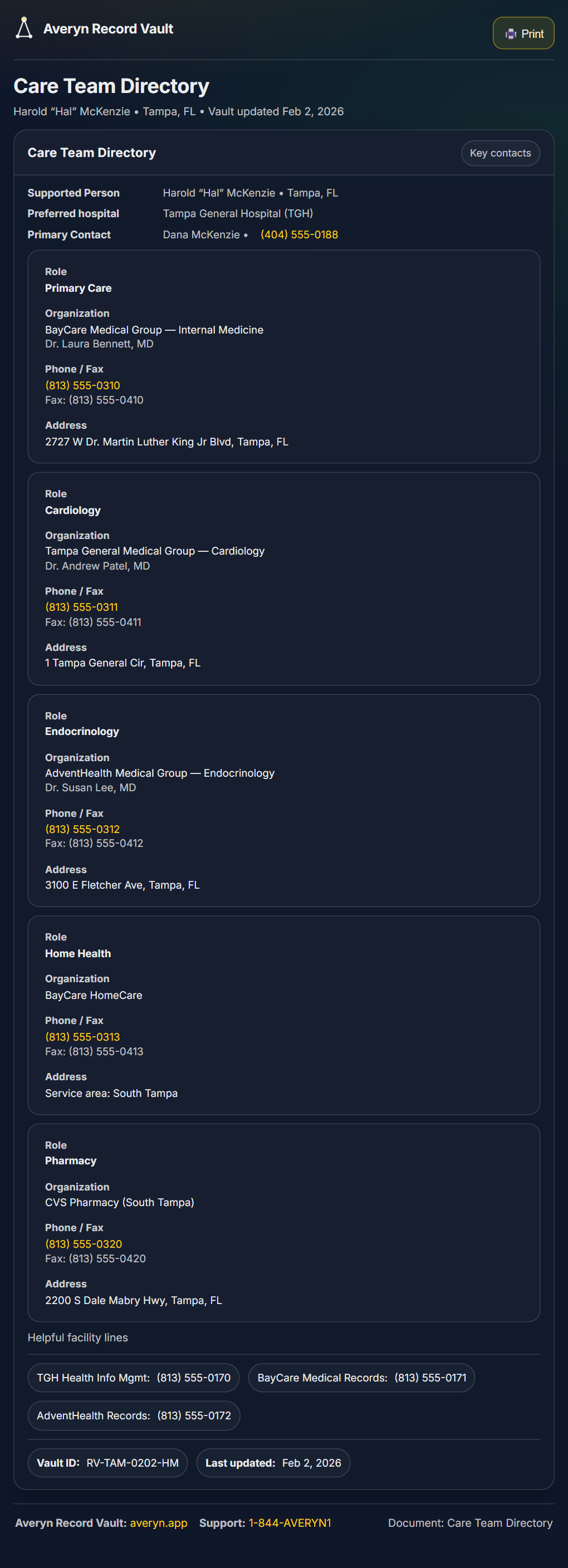
- Care Team Directory
- Authorization & Access Snapshot
- Authorization Packet and Tracker
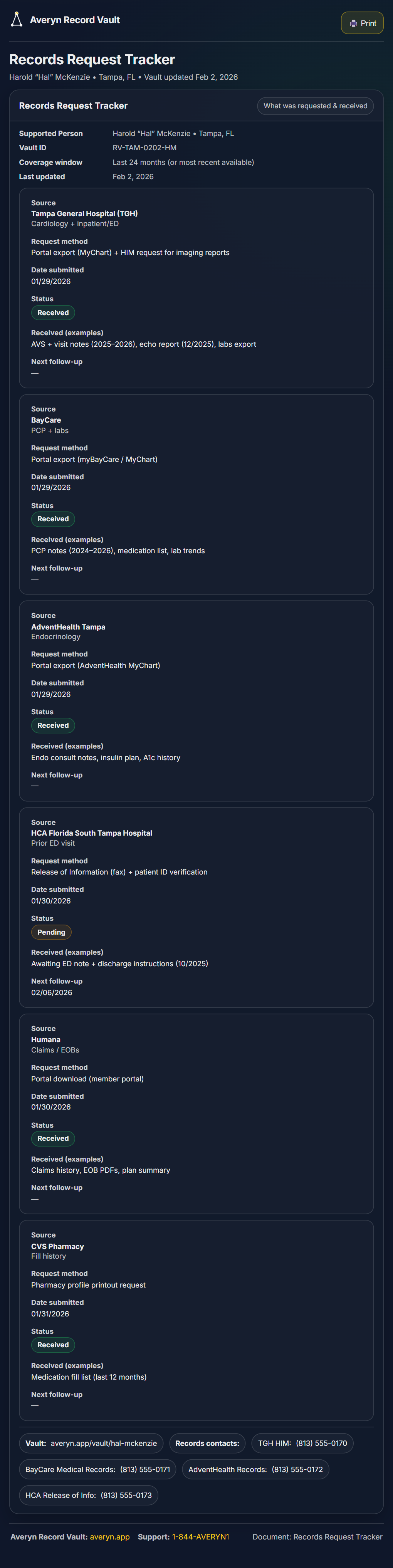
- Records Request Tracker
- Baseline Records Repository
- Baseline Snapshot Summary
- Upcoming Commitments List
- Family Alignment Call (within 30 days of delivery)
Scroll down to preview featured deliverables — or jump to the examples.
See what's inside the Vault
Every Record Vault includes structured, shareable documents built for real situations — an ER visit, a first appointment with a new specialist, or when a family member needs to get oriented fast.
Each example below uses fictional patient details. The structure is the point.
Baseline Snapshot Summary
What you're looking at: A one-page, ER/new-provider-ready summary that captures the patient's documented history and current state in plain English.
What it includes:
- Key conditions and risks (e.g., CHF, diabetes, fall risk)
- Current medication list (as recorded in the most recent documents)
- Allergies and functional notes (mobility, living situation)
- Core care team contacts and recent care milestones
- "Active plans and follow-ups" — a summary of documented instructions (not a new care plan)
Why it matters: When a long-time doctor retires and you're assigned someone new, or you end up in the ER at 2 a.m., you get asked the same questions repeatedly — and the answers are scattered across portals. This sheet gives clinicians a clean starting point so you're not reconstructing your history from memory.
This is a non-clinical, administrative summary based on the records in the Vault. It does not create or replace a medical care plan or clinical judgment.
Also included in every Vault
Beyond the featured documents above, the Record Vault also includes these supporting pieces.
A one-page snapshot of authority and access: who is allowed to speak for the patient, which authorizations are on file, and where portal proxy access is active vs. not available. This is the document that prevents the classic, painful moment: "We can't talk to you without the right authorization."
The cover sheet for the Vault binder — a simple index that shows what categories exist, where to find things, and what's included. It also suggests a "quick hand-off packet" — what to share first with new providers or the ER. The Vault isn't just a pile of PDFs; this index makes it navigable.
HIPAA authorizations and release forms routed and submitted where required; tracker shows submitted, pending, and blocked items plus next steps.
Documents organized by provider/system and date — structured so a new physician or second opinion can quickly review.
Known upcoming appointments, renewals, and active care requests — enough to make "what's next" obvious.
One Family Alignment Call is included. It must be held within 30 days after the initial Vault delivery — a chance to walk through findings, reset roles, and confirm next steps.
When the Vault matters most
You don't need a crisis to start. But certain moments make the value obvious — and the cost of not having it real.
You're assigned someone new who has never seen you. Explaining 15 years of history in a 15-minute visit feels impossible — so you avoid the visit entirely. The Vault gives your new provider a portable baseline so you're not starting from zero, and your navigator handles the records transfer so the transition actually happens.
New patient forms, records requests, prior authorizations — the logistics barrier is high enough to make people quietly defer care they actually need. The Vault lowers that barrier: your records are already organized, your navigator handles the paperwork chain, and you actually follow through.
Some people start the Vault because they know complexity is coming — more providers, a spouse aging alongside them, or simply the recognition that scattered portals and fragmented records become a real problem eventually. Better to build the system now than scramble later.
The Vault doesn't require a family network. It works for one person managing their own care. If you want to add someone to the account later — a neighbor, a friend, an adult child — they'll inherit the full picture. But it starts with just you.
Timing and delivery
From kickoff (assuming participation requirements are met), the initial Vault delivery includes:
- Vault structure is live
- Access and authorization tracker is live
- Records requests submitted to all identified providers/systems
- All records received to date organized in the repository
- Baseline snapshot summary delivered from records received to date
Some providers take the maximum HIPAA-allowed time to respond — generally 30 calendar days, with a permitted extension up to 60 calendar days.
- One Vault Refresh delivery when late records arrive — typically within 30–60 days depending on provider turnaround
- We attempt digital retrieval first; where providers only support mail/fax, we still pursue and track progress
High complexity criteria
High complexity is not a judgment — it's a capacity signal. It usually means more portals, more record sources, more authorizations, and more follow-up cycles.
The +$400 High Complexity Capacity add-on applies if any of the following are true at intake:
- 5+ active providers involved in the last 6 months
- 3+ health systems / portal ecosystems (distinct EHR portals)
- Recent or upcoming transition in the next 60 days (hospitalization, rehab/SNF, surgery, move, new diagnosis)
- Two or more payer/benefit contexts that materially affect record flow
Check your estimated Vault cost
Answer three quick questions to see whether the High Complexity add-on likely applies. No personal or health information needed.
Participation requirements
The Record Vault is collaborative — we do the chasing, but we need the household to enable it. To qualify for the Record Vault Guarantee and to stay on the 10-business-day initial timeline:
- Kickoff attendance: Primary Contact attends the kickoff
- Identity and insurance info: provide IDs/insurance details within 5 business days (or request an extension)
- Authorization turnaround: sign and return required releases within 72 hours of receipt (or request an extension)
- Provider list confirmation: confirm providers/systems and recent care locations promptly
- Responsiveness: respond to approvals and clarifying questions within 2 business days during the build
- Single decision path: one Primary Contact model; no conflicting instructions
Record Vault Guarantee
If participation requirements are met and Averyn does not deliver the Initial Vault Delivery by the agreed end date, your household may choose:
Full refund of the Record Vault fee, including the deposit.
100% credit of the Record Vault fee toward future subscription invoices or add-ons (credit expires after 12 months).
This guarantee covers deliverables we control (submission, tracking, packaging). It does not guarantee provider turnaround times; HIPAA access timing includes a permitted extension (up to 60 days total) in certain circumstances.
The Vault is just the beginning
The Record Vault gives your family a clear starting point. When you continue with an Averyn Navigation Plan, your navigator keeps that foundation current — and the deliverables keep coming.
Structured updates that keep the whole household aligned on what moved, what's blocked, and what's next — without relying on the patient to relay everything.
Same-day written updates during an inpatient stay, plus a discharge packet with responsibilities, follow-ups, and a four-week runway for the transition home.
See real sample deliverables — weekly summaries, hospitalization briefings, discharge packets, and coordination timelines — on our examples page.
What if I don't continue with a Navigation Plan?
The Record Vault is yours to keep — it was designed that way. Your organized record bundle, summaries, and deliverables remain available for download and sharing whether or not you subscribe to a Navigation Plan.
Without a Navigation Plan, the Vault becomes a finished artifact: you can view, download, and share everything that was delivered, but new records won't be added and your navigator won't be maintaining or updating the contents.
If your situation changes later, you can pick up with a Navigation Plan and your navigator will resume keeping the Vault current.
What comes next: your Averyn Navigation Plan
The Record Vault is the required first step. Once complete, your household can choose the Navigation Plan that fits — your navigator keeps tasks moving, loose ends tied off, and your family aligned.
A structured foundation with light human support and escalation when needed.
Annual commitment rate. Month-to-month: $77/mo.
Active follow-through on scheduling, referrals, and paperwork with a dedicated navigator and weekly updates.
Annual commitment rate. Month-to-month: $324/mo.
Reserved, high-touch capacity for complex or changing situations with frequent coordination.
Annual commitment rate. Month-to-month: $1,039/mo.
 Daily coordination? Averyn Anchor ($2,999/mo) for daily coordination with caregivers and transitions.
- We don't sell personal information — not to advertisers, data brokers, or anyone else
- Permission-based — we never contact a provider without your authorization
- HIPAA-aligned infrastructure — every vendor we depend on operates at HIPAA-compliant standards
- You control who's in — add or revoke family and caregiver access anytime from the app
- Navigators vetted — background checks, OIG and federal exclusion screening
- Your data stays in the US — all health-related data stored in US data centers
Ready to get your records organized?
Reserve your start date with a $199 deposit, or start with a short conversation to confirm fit and walk through the process. Either way, your navigator begins within days.
Deposit applies to the $999 Record Vault fee. 10 business day delivery target with a guarantee.