Averyn Record Vault
Averyn Record Vault
Averyn Record Vault

Provider records tell one story.
Your family knows the rest.

  • Records gathered, organized, and source-labeled
  • Your family's context preserved alongside
  • Proxy access established — yours to keep
  • A portable briefing for every appointment and transition
Baseline Snapshot Summary — conditions, medications, care team, and follow-ups in plain English
Baseline Snapshot Summary
Records Request Tracker — every source identified, requested, and tracked
Records Request Tracker
Care Team Directory — providers, contacts, and the right way to reach each office
Care Team Directory
Averyn Record Vault
Step 2 in the Averyn process

Start with a clear picture — the Averyn Record Vault

Provider records serve billing, compliance, and the provider's version of events — not clean continuity for the family. The Record Vault brings together official records and your family's context into a portable, source-labeled briefing you can review, annotate, and carry forward to every new provider, appointment, and transition.

Your Initial Vault arrives in about 10 business days — assembled from portals, pharmacy data, insurance info, and the documents your family already has. It grows as slower providers respond. The Vault and the proxy access established during the build are yours to keep whether or not you continue with Averyn.

Already decided? Skip the intro call and lock in your start date. $199 applies to the $999 Vault fee. Limited spots each month.

How it works

Three steps — start with one, add what you need.

What the Record Vault actually is

The Record Vault is not a software subscription. It's a fixed-scope project where a real person does the work of getting your household's medical records organized — and delivers the result in a format that's useful whether or not you stay with Averyn.

Deeper than a portal export
We pull the records that actually matter

We start by reviewing your insurer's claims data to identify billing providers — then build from there with the providers and care history your family names directly. We request records from the providers identified through claims review and the care history your family names directly.

That includes home health agencies, physical therapy, occupational therapy, and other providers that don't have patient portals — records returned via fax, mail, or email. We pull the actual clinical notes, not just your last lab panel or vaccination history. Pharmacy fill records show what's actually being dispensed across all your pharmacies.

If a provider has retired or records have aged past a facility's retention period, those gaps will be documented in your Records Request Tracker so you know exactly what's complete and what isn't.

Why the depth matters
The handoff problem nobody warns you about

Your patient portal accumulates history from one health system — but it isn't reconciled with external specialists, smaller practices, or home care providers. Handoff documentation between systems is thin.

When you need a new specialist, a new home health provider, or you're preparing for an intake — the information gap is real. A single hospitalization can generate hundreds of pages of documentation across hospitalists, case managers, therapists, and home care providers. Your new doctor often won't have time to read all of it.

The Record Vault organizes that history and produces plain-English summaries so you can pack a meaningful conversation into a 15-minute appointment — or so your Care Continuity Partner can accurately draft intake documents and coordinate on your behalf.

With AI tools increasingly summarizing and reusing older notes, those inaccuracies can get amplified faster — making a family-owned, source-labeled record more important than ever.

How you access it
The Averyn App — no download required

Your organized records, summaries, and documents live in the Averyn App — a secure, browser-based platform that works on any phone, tablet, or computer. No app store download needed.

Everyone involved in care gets their own login. The Record Vault is one feature of the app — designed as the central collaboration hub for the household, with shared visibility into documents, requests, and updates.

Authorization infrastructure — yours to keep
Half the care team won't talk to you without proper authorization. We fix that.

You're managing everything — but many providers will turn you away without documented authorization. During the Vault build, we submit HIPAA authorizations and establish proxy portal access for both you and Averyn. You get your own login to each system, not the patient's. A Permissions and Access Map documents exactly who you can talk to and how.

This is permanent infrastructure your family keeps whether or not you continue with Averyn. After the Vault, you have the legal standing to call providers, access portals, and get answers — so the next time you need to coordinate something, you're not starting from "we can't discuss that with you."

No lock-in. The organized foundation is yours.

Export all original documents, the file index, and every summary to a ZIP file at any time. If you don't continue with a Continuity Plan, we deliver the full export — the hard work was getting organized. Whoever maintains it going forward starts with everything in place.

Family Alignment Call included
The moment your family takes ownership of the narrative

Your CCP drafts the Baseline Snapshot from provider records and the patient history interview. At the included Family Alignment Call, your family reviews it and adds what the records miss: what doesn't match your experience, what's actually happening at home, what worked and what didn't.

Every item is tagged with provenance — provider-documented, family-reported, portal-confirmed, or pending clarification — so a new doctor can immediately see what came from the chart and what came from the family. After the call, the Vault is a source-labeled family continuity briefing, not just a record collection.

What the Vault enables
The foundation for everything your CCP does

The curated record and authorization infrastructure make ongoing coordination possible. Your CCP shows up to every call, every provider interaction, and every transition already knowing the full picture — so nobody starts from scratch.

  • Appointment attendance: Your CCP sits in as the family historian, carrying curated context so you don't have to remember every detail.
  • New providers: A specialist joining your care team gets a source-labeled briefing instead of a fax with three lines.
  • Home health onboarding: A new agency or aide gets oriented from the Vault in minutes.
  • Transitions: During a hospitalization or rehab stay, the Vault is the portable briefing that prevents the next setting from inheriting partial truth.

How the Record Vault gets built

The Vault isn't a portal export or a records request. It's a staged build where your Care Continuity Partner does the administrative startup work most families try to piece together on their own.

What can slow things down

Provider turnaround times vary. Some offices require extra forms. Some portals need the Supported Person on a live call. Some records reveal additional providers mid-build. None of this is unusual.

Kickoff and household interview

We meet with your family to identify the Supported Person, confirm the Primary Contact, gather insurance and identification details, and review the providers and care systems you already know about.

We start HIPAA authorizations, portal access, and any provider-specific release forms needed to begin.

Patient history interview + Care Ledger

We also conduct a patient history interview — the kind of conversation a thoughtful new clinician would do on day one — and begin fleshing out your Care Ledger: the hands-on, day-to-day reality of care at home that is almost never captured in formal records.

Access, portals, and pharmacy setup

Your Care Continuity Partner establishes the Averyn coordination identity for your household, sends family invitations to averyn.app, requests records across the identified care ecosystem, and begins proxy or portal access work where available.

We also work to establish pharmacy online access and link your pharmacies so the medication picture starts coming together.

Provider-specific requirements

Some offices require their own authorization form even after a general HIPAA release. Some portals require the Supported Person on a live call for identity verification. When that happens, we coordinate the call and keep it brief.

Records collection and first organization pass

As records arrive, your Care Continuity Partner sorts, labels, and organizes them inside your Record Vault. We start building the care team directory, backfilling recent visits and hospitalizations onto your calendar, and assembling a medication snapshot based on what you're actually taking — not just what may still appear on an outdated hospital list.

Conditions and allergies are documented as they appear across sources. Your family starts seeing useful structure before the build is fully complete.

What's taking shape

  • Care Team Directory
  • Calendar Foundation
  • Medication Snapshot
  • Condition & Allergy Inventory

Gap chasing and reality checking

We identify what's still missing: providers who haven't responded, records that reveal additional care relationships nobody mentioned, conflicting medication information between sources, and gaps between what the chart says and what's actually happening at home.

This round often surfaces smaller providers, therapy groups, rehab stays, home health notes, and portal-only messages that never appear in a clean exchange feed.

If something needs your signature

If a provider requires another signature, consent, or release, we route that back to the Supported Person or authorized decision-maker quickly so the request keeps moving.

Snapshot drafting and household review

We prepare your Baseline Snapshot — a plain-English summary that distills your records into something usable for family, home care helpers, and new providers. It's designed so a new doctor can orient to where you are today without reading hundreds of pages.

Then we ask the Supported Person or caregivers to review it, comment on critical facts we may be overlooking, and help refine it into a curated source of truth — not just an autogenerated summary.

Delivery, refresh, and continuity handoff

At delivery, your household has an organized, portable Record Vault. You can export everything to regular files at any time.

What you receive

  • Organized records by provider and date
  • Care Team Directory
  • Calendar Foundation
  • Medication Snapshot
  • Care Ledger Foundation
  • Records Tracker (received + pending)
  • Reviewed Baseline Snapshot

What happens next

When late records arrive, we complete the included refresh. Most families continue into an ongoing Continuity Plan so the same Care Continuity Partner keeps handling the scheduling, portals, referrals, paperwork, and family updates that continue after the build.

1 of 6

Record Vault pricing

A fixed-scope, one-time engagement. Vault work begins only after the Vault fee is paid in full.

Base price
Record Vault icon Averyn Record Vault
$999

Includes the full Vault package for one Supported Person (the person receiving care). Reservation deposit of $199 applies to the total.

  • $199 reservation deposit — reserves your start date; applies to the Vault fee
  • Remaining $800 — auto-charged before kickoff
  • Vault work begins only after full payment clears
Reserve a start date — $199 deposit

Already decided? Skip the call — your Care Continuity Partner begins within days.
Prefer to talk first? Book a 15-min intro call.

Optional add-ons
When your situation needs more
High Complexity Capacity add-on
Required when complexity criteria are met.
+$400
Additional Supported Person (same household, requiring care)
Incremental portals, authorizations, record sources, and summary work.
+$400 each

What your household receives

The Record Vault produces a portable, shareable record bundle plus an administrative, plain-English summary. Everything is designed so a new physician, ER team, or second opinion can quickly review the picture.

Records & access

  • Baseline Records Repository — organized by provider and date, not by portal
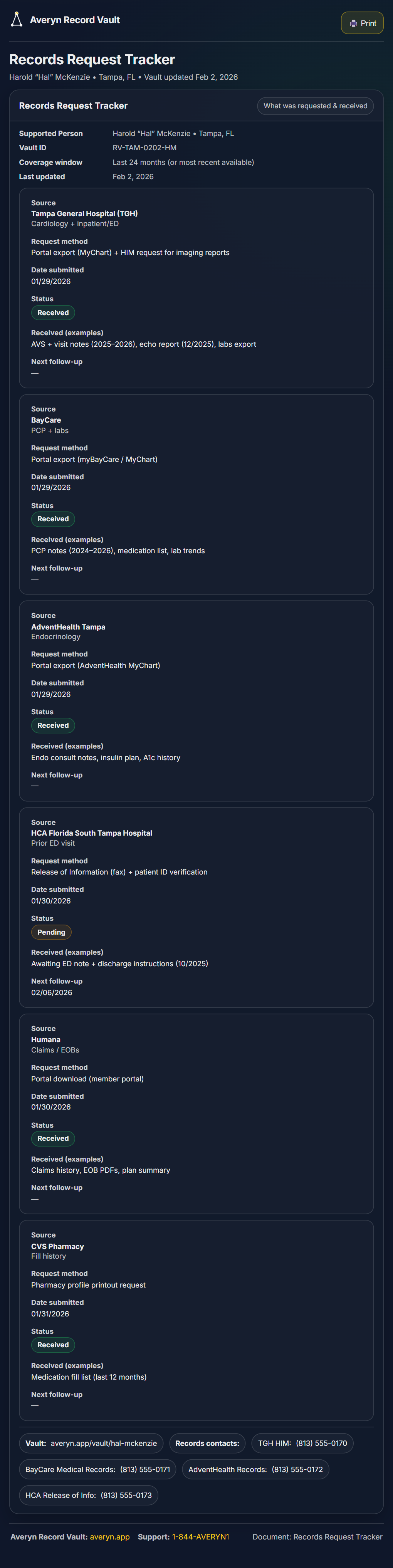
  • Records Request Tracker — what was sent, received, and still pending
  • Authorization Packet and Tracker
  • Authorization & Access Snapshot — portals, proxies, pharmacy accounts

Structured picture

  • Care Team Directory — every identified provider, role, contact, and last visit
  • Medication Snapshot — what's actually being taken, reconciled across sources
  • Condition & Allergy Inventory — documented across all collected records
  • Calendar Foundation — upcoming appointments, recurring visits, and commitments

Summaries & handoff

  • Baseline Snapshot Summary — plain-English, new-provider-ready overview
  • Care Ledger Foundation — the day-to-day reality of care at home that formal records miss
  • Family Alignment Call — within 30 days of delivery

Scroll down to preview featured deliverables — or jump to the examples.

See what's inside the Vault

Every Record Vault includes structured, shareable documents built for real situations — an ER visit, a first appointment with a new specialist, or when a family member needs to get oriented fast.

Each example below uses fictional patient details. The structure is the point.

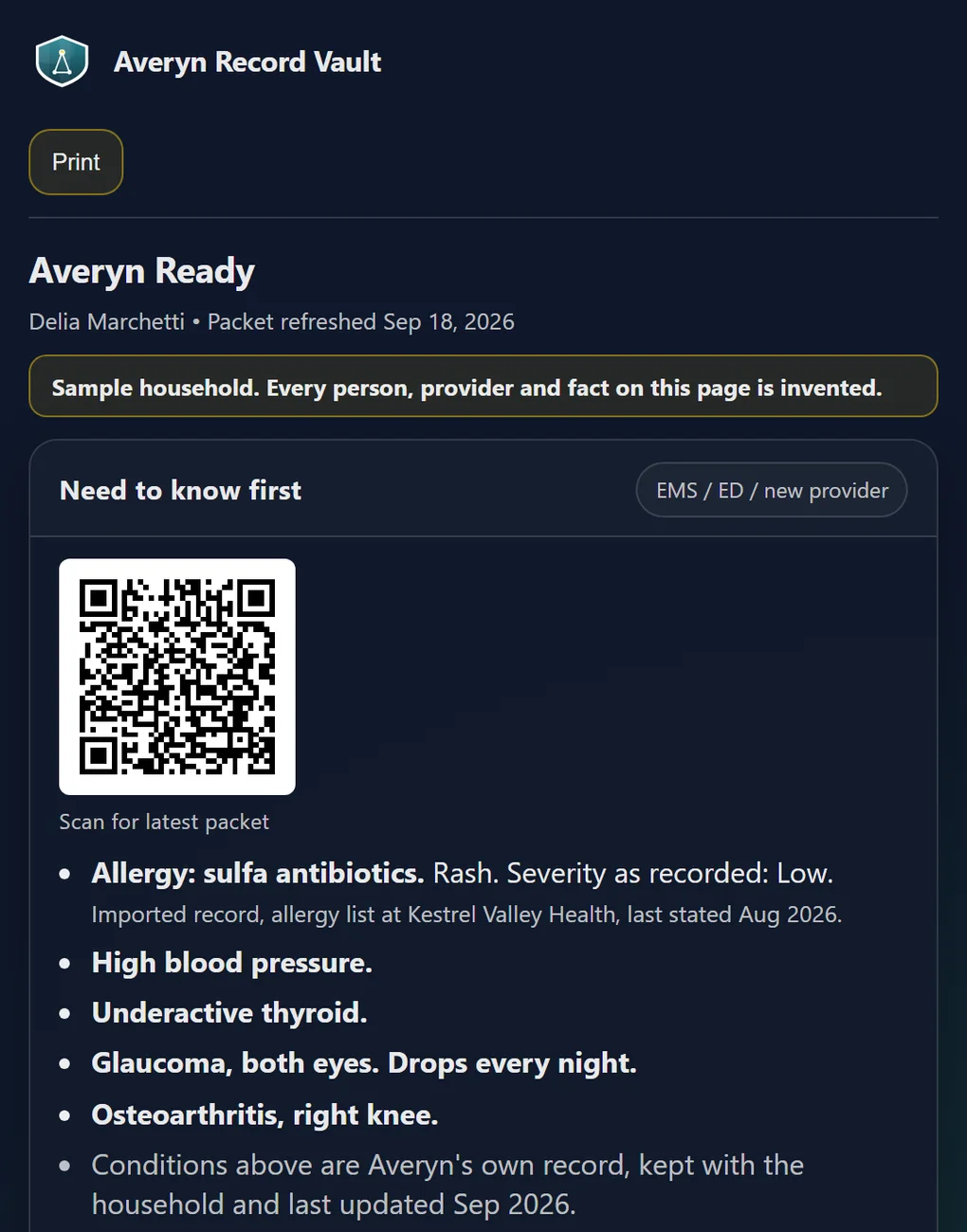
Baseline Snapshot Summary

What you're looking at: A one-page, ER/new-provider-ready summary that captures the patient's documented history and current state in plain English.

What it includes:

  • Key conditions and risks (e.g., CHF, diabetes, fall risk)
  • Current medication list (as recorded in the most recent documents)
  • Allergies and functional notes (mobility, living situation)
  • Core care team contacts and recent care milestones
  • "Active plans and follow-ups" — a summary of documented instructions (not a new care plan)

Why it matters: When a long-time doctor retires and you're assigned someone new, or you end up in the ER at 2 a.m., you get asked the same questions repeatedly — and the answers are scattered across portals. This sheet gives clinicians a clean starting point so you're not reconstructing your history from memory.

This is a non-clinical, administrative summary based on the records in the Vault. It does not create or replace a medical care plan or clinical judgment.

Also included in every Vault

Beyond the featured documents above, the Record Vault also includes these supporting pieces.

Authorization & Access Snapshot

A one-page snapshot of authority and access: who is allowed to speak for the patient, which authorizations are on file, and where portal proxy access is active vs. not available. This is the document that prevents the classic, painful moment: "We can't talk to you without the right authorization."

Vault Contents Index

The cover sheet for the Vault binder — a simple index that shows what categories exist, where to find things, and what's included. It also suggests a "quick hand-off packet" — what to share first with new providers or the ER. The Vault isn't just a pile of PDFs; this index makes it navigable.

Authorization Packet and Tracker

HIPAA authorizations and release forms routed and submitted where required; tracker shows submitted, pending, and blocked items plus next steps.

Baseline Records Repository

Documents organized by provider/system and date — structured so a new physician or second opinion can quickly review.

Upcoming Commitments List

Known upcoming appointments, renewals, and active care requests — enough to make "what's next" obvious.

Family Alignment Call

One Family Alignment Call is included. It must be held within 30 days after the initial Vault delivery — a chance to walk through findings, reset roles, and confirm next steps.

When the Vault matters most

You don't need a crisis to start. But certain moments make the value obvious — and the cost of not having it real.

Provider transition
A long-time doctor retires or closes their practice

You're assigned someone new who has never seen you. Explaining 15 years of history in a 15-minute visit feels impossible — so you avoid the visit entirely. The Vault gives your new provider a portable baseline so you're not starting from zero, and your Care Continuity Partner handles the records transfer so the transition actually happens.

Referral chains
A specialist referral arrives and you can't face another intake

New patient forms, records requests, prior authorizations — the logistics barrier is high enough to make people quietly defer care they actually need. The Vault lowers that barrier: your records are already organized, your Care Continuity Partner handles the paperwork chain, and you actually follow through.

Being prepared
Nothing is wrong yet — but you want the infrastructure in place

Some people start the Vault because they know complexity is coming — more providers, a spouse aging alongside them, or simply the recognition that scattered portals and fragmented records become a real problem eventually. Better to build the system now than scramble later.

On your own
You don't have family nearby to coordinate for you

The Vault doesn't require a family network. It works for one person managing their own care. Providers assume someone accompanies you who knows your full history — medications, what the last specialist said, when symptoms started. When there's no one filling that role, things get missed.

Your Care Continuity Partner becomes that person — the family historian of your care. If you want to add someone to the account later — a neighbor, a friend, an adult child — they'll inherit the full picture. But it starts with just you.

When you can probably handle this yourself

If your situation is straightforward — one provider, one or two portals, no recent transition, and you have the time and patience to request records, set up proxy access, and keep everything current — you may not need the Vault. We'd rather be honest about that.

When most families find that DIY breaks down

Five or more active providers. Three or more portal ecosystems. A recent discharge or upcoming transition. Multiple payer contexts. At that point, the volume of requests, the hold time, the authorization paperwork, and the portal juggling outpace what one person can sustain between everything else they're carrying.

There are also more records than most people realize.

Patients often overlook records from home health, PT/OT, one-off specialist visits, or short-term rehab. Those providers typically do not share their progress notes or clinical opinions back to your primary care doctor — leaving gaps in your full picture. The next time you need those records (a new specialist, a transition, a second opinion), they won't be available unless someone collected them. The Record Vault captures records across your entire care ecosystem, not just what your PCP has on file.

What records often miss — and why it matters

Most families assume their doctor has the full picture. The reality is more fragmented than it looks, and the gaps have real consequences.

Providers don't share back automatically

Home health agencies, PT/OT practices, short-term rehab facilities, and one-off specialists typically do not send their notes or clinical opinions back to your primary care doctor. Your PCP may not know what a wound care nurse observed, what a PT recommended, or what a consulting cardiologist changed. Those records exist — but only in the originating office unless someone requests them.

Health information exchanges have real limits

HIEs and patient portals can surface some data, but coverage is uneven. Not all providers participate. Smaller practices, home health agencies, and behavioral health providers are often excluded. Even when connected, what flows through an HIE is usually limited to discharge summaries and lab results — not progress notes, therapy assessments, or the clinical reasoning behind a treatment change.

Why health records aren't as connected as you'd expect →

Medication lists conflict across sources

A hospital discharge list may include medications that were stopped. A specialist may have adjusted a dose that the PCP's chart hasn't caught up with. What's listed in a portal may not match what's actually in the medicine cabinet. The Vault reconciles what we find across sources so the medication picture reflects current reality — not just whichever system was updated last.

The chart says one thing; home looks different

Formal records capture what happened in a visit. They rarely capture what's happening between visits — mobility changes, missed meals, confusion about instructions, a caregiver who stopped coming, or a fall that didn't result in an ER visit. The Care Ledger interview during the Vault build captures this operational layer so it doesn't stay invisible.

None of this is unusual. It's the default state of healthcare records for anyone seeing more than a couple of providers. The Vault build is designed around this reality — not the assumption that records are already organized somewhere.

Timing and delivery

Initial delivery
10 business day target

From kickoff (assuming participation requirements are met), the initial Vault delivery includes:

  • Vault structure is live
  • Access and authorization tracker is live
  • Records requests submitted to all identified providers/systems
  • All records received to date organized in the repository
  • Baseline snapshot summary delivered from records received to date
Late-arriving records
One Vault Refresh included

Some providers take the maximum HIPAA-allowed time to respond — generally 30 calendar days, with a permitted extension up to 60 calendar days.

  • One Vault Refresh delivery when late records arrive — typically within 30–60 days depending on provider turnaround
  • We attempt digital retrieval first; where providers only support mail/fax, we still pursue and track progress

High complexity criteria

High complexity is not a judgment — it's a capacity signal. It usually means more portals, more record sources, more authorizations, and more follow-up cycles.

The +$400 High Complexity Capacity add-on applies if any of the following are true at intake:

  • 5+ active providers involved in the last 6 months
  • 3+ health systems / portal ecosystems (distinct EHR portals)
  • Recent or upcoming transition in the next 60 days (hospitalization, rehab/SNF, surgery, move, new diagnosis)
  • Two or more payer/benefit contexts that materially affect record flow

Check your estimated Vault cost

Answer three quick questions to see whether the High Complexity add-on likely applies. No personal or health information needed.

1. How many healthcare providers are actively involved?
2. How many different patient portals or health systems are in play?
3. Is there a major transition in the next 60 days? (hospitalization, rehab, surgery, move, new diagnosis)

What your family is asked to do

We do the chasing, the calls, the portal work, and the organization. But we need a few things from your household to keep the build moving — especially in the first week.

1

Show up for the kickoff

The Primary Contact — the family member directing priorities — joins the kickoff call. This is where we map the care landscape, identify providers, and start authorizations.

2

Send IDs and insurance info within 5 business days

We need basic identification and insurance details to start records requests and authorization work. Extensions are available if you need more time.

3

Sign authorizations within 72 hours

HIPAA releases and any provider-specific forms. Some providers require their own signature even after a general release — we route those to you as they come in. Extensions are available.

4

Confirm providers and respond to questions during the build

Help us make sure we have the right provider list up front, and respond to clarifying questions within 2 business days. If a portal requires the Supported Person on a live call for identity verification, we coordinate that and keep it brief.

5

One Primary Contact, one decision path

We work from a single Primary Contact to avoid conflicting instructions. That person can change, but at any given time there's one clear decision-maker.

HIPAA authorization required: The Record Vault requires signed HIPAA authorization from the Supported Person — or from someone who already holds a valid Power of Attorney (POA) or healthcare proxy. Without this, providers cannot release records to Averyn or to the family.
Extension rule: If the household requests an extension that pushes the Vault Build beyond 30 calendar days from kickoff, the Record Vault Guarantee is forfeited (work can continue).

Record Vault Guarantee

If participation requirements are met and Averyn does not deliver the Initial Vault Delivery by the agreed end date, your household may choose:

Option 1
Full refund

Full refund of the Record Vault fee, including the deposit.

Option 2
100% credit

100% credit of the Record Vault fee toward future subscription invoices or add-ons (credit expires after 12 months).

This guarantee covers deliverables we control (submission, tracking, packaging). It does not guarantee provider turnaround times; HIPAA access timing includes a permitted extension (up to 60 days total) in certain circumstances.

The Vault is just the beginning

The Record Vault gives your family a clear starting point. When you continue with an Averyn Continuity Plan, your Care Continuity Partner keeps that foundation current — and the deliverables keep coming.

Weekly family summaries

Structured updates that keep the whole household aligned on what moved, what's blocked, and what's next — without relying on the patient to relay everything.

Hospital briefings

Same-day written updates during an inpatient stay, plus a discharge packet with responsibilities, follow-ups, and a four-week runway for the transition home.

See real sample deliverables — weekly summaries, hospitalization briefings, discharge packets, and coordination timelines — on our examples page.

What if I don't continue with a Continuity Plan?

The Record Vault is yours to keep — it was designed that way. When you're done, we export all original documents, the standalone file index, and every summary document Averyn produced into a ZIP file you can download and store on your own computer, Google Drive, or wherever you keep important files.

The true value of the Record Vault is the work it takes to get organized — the deliverable is that organized set. Whoever is on point to manage care going forward, whether that's you or Averyn, now has the foundation to succeed with everything in place.

Without a Continuity Plan, the Vault becomes a finished artifact: you can view, download, and share everything that was delivered, but new records won't be added and your Care Continuity Partner won't be maintaining or updating the contents.

If your situation changes later, you can pick up with a Continuity Plan and your Care Continuity Partner will resume keeping the Vault current.

What comes next: your Averyn Continuity Plan

The Record Vault is the required first step. Once complete, your household can choose the Continuity Plan that fits — your Care Continuity Partner keeps tasks moving, loose ends tied off, and your family aligned.

Light-touch follow-through
Essentials
$59 /month

Stable situation, minimal coordination needs. Scheduled check-ins, written updates, and lighter-touch support when something needs attention.

Annual commitment rate. Month-to-month: $77/mo.

Weekly coordination
Dedicated
$799 /month

Something care-related happening most weeks — new loose ends appearing regularly. Weekly working conversation with your Care Continuity Partner.

Annual commitment rate. Month-to-month: $1,039/mo.

Anchor plan Daily coordination? Averyn Anchor ($2,999/mo) — home plan is fragile, daily coordination to keep it together.

See full plan details, add-ons, and prepay bonus →

How we protect your family's information
  • We don't sell personal information — not to advertisers, data brokers, or anyone else
  • Permission-based — we never contact a provider without your authorization
  • HIPAA-aligned infrastructure — every vendor we depend on operates at HIPAA-compliant standards, even though Averyn is not a covered entity
  • Confidentiality bound — all Averyn employees sign confidentiality and non-disclosure agreements
  • Team vetted — background checks, OIG and federal exclusion screening
  • You control who's in — add or revoke family and caregiver access anytime from the app
  • Your data stays in the US — all health-related data stored in US data centers
Start here

Ready to get your records organized?

Most families start with a quick intro call. Already know you’re ready? The $199 deposit skips the call and locks in your start date — your Care Continuity Partner begins within days.

$199 applies to the $999 Vault fee. Limited start dates each month. 10 business day delivery with a guarantee.