

The person who follows through relentlessly
You’ve already watched a referral expire because nobody followed up. You’ve called the same office three times and still don’t have the records. You’ve forwarded the same update to four siblings because there’s no shared system.
Your navigator takes ownership of the administrative follow-through that no one else in the system is responsible for — and stays on it until it closes.
Who we hire — and why it matters
We don’t hire clinical staff. We don’t hire advisors. We hire people who are relentless at getting things done inside bureaucratic systems — and who treat your family’s situation like it’s the most important thing on their list, because it is.
Your navigator understands what it feels like to be buried by logistics you didn’t choose. They listen before they act, and they ask before they assume.
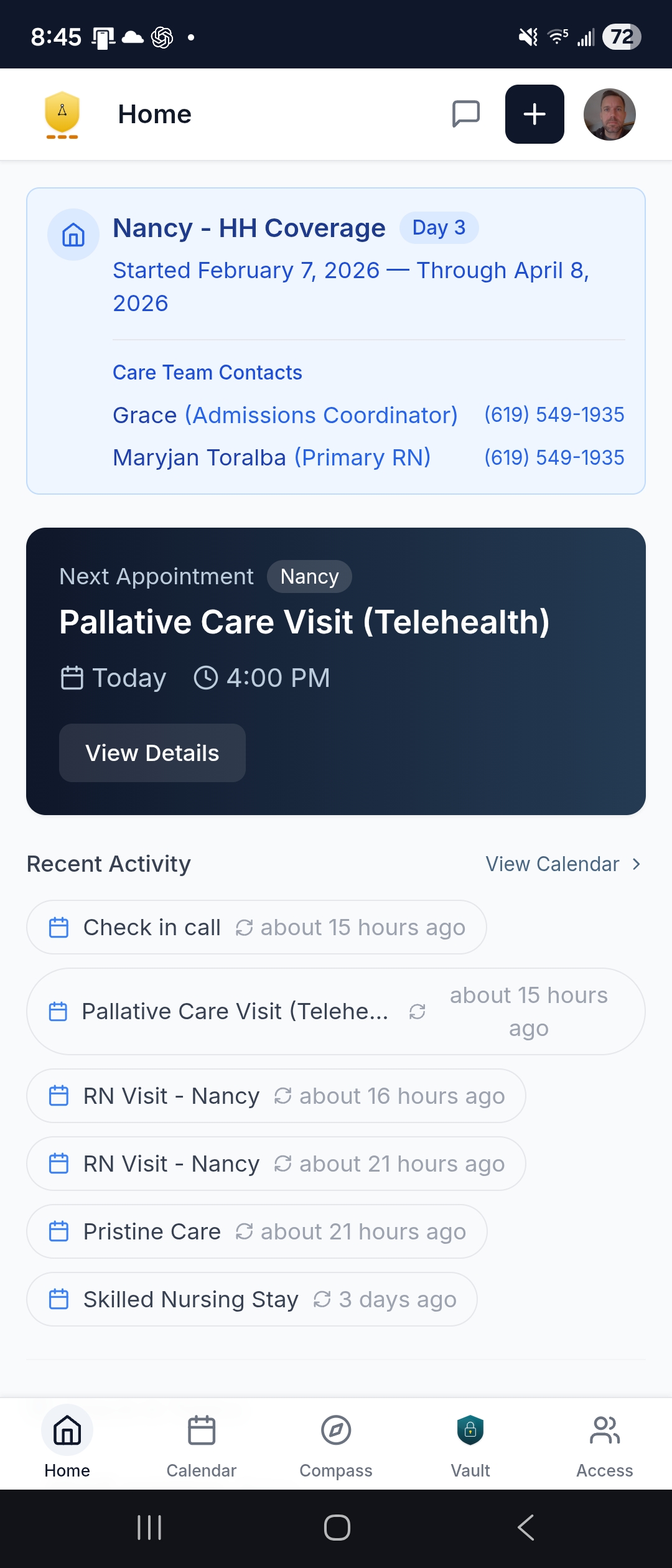
Every task, document, message, and next step lives in the Averyn app — tracked, timestamped, and visible to you. Nothing stays in someone’s head.
Referrals don’t close themselves. Records don’t arrive on their own. Your navigator follows up, re-follows-up, and escalates until the loop is closed.
What a week actually looks like
Not a feature list. A real operating rhythm.
The referral that’s been pending for three weeks
Your navigator calls the specialist’s office for the third time. Gets the fax number confirmed. Sends the referral directly. Logs a follow-up for Thursday to confirm receipt.
The pharmacy callback and the insurance question
90-day supply was denied. Navigator calls the pharmacy, then the insurer, gets the prior auth form, coordinates with the prescriber’s office. Logs the PA number and expected turnaround in the app.
The portal message that went unanswered
Your mom’s PCP office replied to a portal message four days ago with a question. Nobody saw it. Your navigator catches it, drafts the response, sends it for your approval, and submits it same-day.
Referral confirmed. Appointment scheduled.
The specialist received the referral. Navigator books the appointment, adds it to the care calendar, preps the visit notes with relevant history, and shares details with the family.
Weekly update goes out to the family
A clear written summary: what moved, what’s still open, what’s next. Shared with everyone you’ve authorized. Your sister in Denver, your brother in Chicago, and you — all looking at the same facts. No relay calls.
This is a real operating rhythm, not a best-case scenario. The specifics change — the discipline doesn’t. See real examples →
We build process, not lists
Most families start with a junk drawer of notes — texts to siblings, sticky notes from appointments, portal messages nobody reads, and a mental list that only one person carries.
Your navigator replaces that with a system. Every task is logged in the Averyn app with an owner, a deadline, and a status. Every document is organized and retrievable. Every follow-up has a next step. When something stalls, it doesn’t disappear — it gets escalated.
We build process. We share process. We close on process.
What happens if my navigator changes?
People move on. Navigators take vacations. Someone gets sick on a Wednesday. This is normal — and it’s exactly why everything your navigator does lives in the Averyn app, not in their head.
When a covering navigator steps in — for a sick day, a vacation, or weekend coverage — they have your full history, your open tasks, your care team contacts, and your preferences. They’re not reading cryptic handoff notes. They’re picking up a live system.
If your primary navigator moves on, the replacement doesn’t start over. Your needs are documented. Your care team is mapped. Your communication preferences are set. The Ledger is built — and it transfers cleanly.
This is one of the biggest differences between Averyn and a solo care manager or freelance coordinator. The system outlasts any single person.
The role scales with your needs
Not every family needs the same level of coordination. The navigator role adapts.
Your navigator handles the administrative workload — calls, portals, records, follow-ups, and family updates. You direct priorities; they execute. The cadence is weekly or as-needed.
Most families start here. It covers the vast majority of coordination needs.
Your navigator runs the daily operating rhythm for a home-based care plan — daily caregiver check-ins, a maintained Care Ledger, appointment attendance, and real-time handoff discipline. The cadence is daily.
Designed for households where aging at home depends on rotating caregivers, active transitions, or instructions that change mid-week.
Clear boundaries, by design
Your navigator is non-clinical. They don’t diagnose, interpret test results, give medical advice, or decide what’s urgent. That’s your provider’s job. Your navigator’s job is the administrative follow-through that providers don’t do.
How the family stays aligned
Averyn is built for the Primary Contact, but it stays calm for everyone invited into the work.
Your loved one
Clear, respectful communication focused on practical next steps. No pressure, no theatrics. You can pause or revoke access at any time — you remain the decision-maker.
Siblings and family helpers
Helpers can message the navigator; decisions stay routed through the Primary Contact. We consolidate sibling concerns into one clear narrative, then share the same response back to the group. Everyone sees the same update.
See what your navigator sends
A live preview of a weekly family summary — the kind of clear, written update that replaces the sibling phone chain.
You don’t have to hold it all together anymore.
The referrals get chased. The records get organized. The family gets updated. And you get to stop waking up at 2 am running through the list in your head — because someone else is on it, and it’s all in one place.
That’s not a feature. That’s what follow-through feels like.
Administrative coordination and follow-through; not medical advice.