
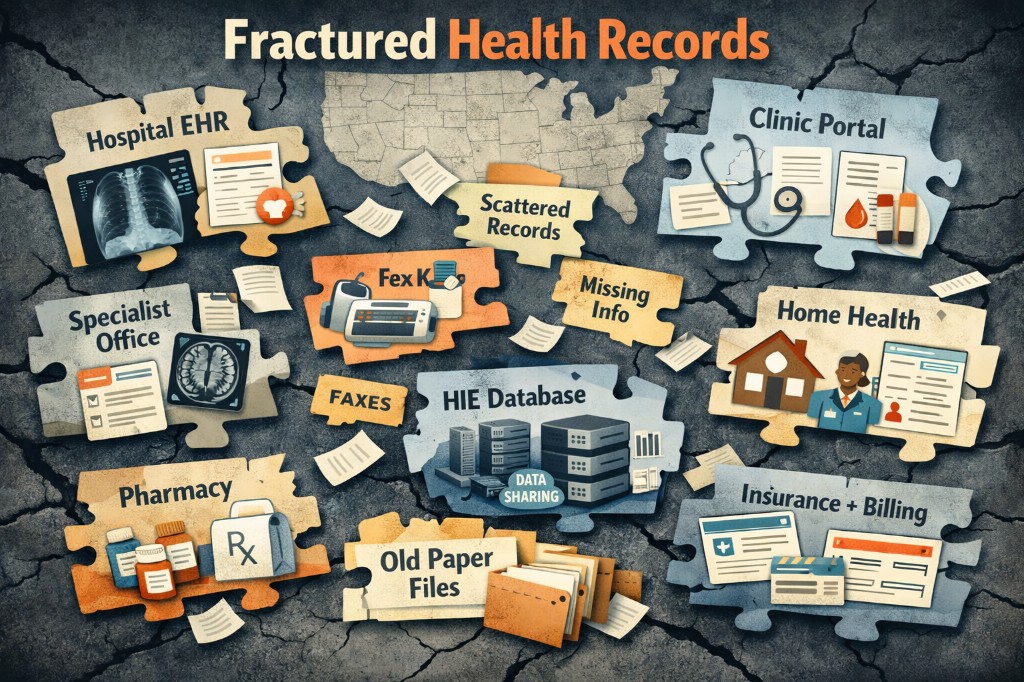
Why your health records aren't as connected as you think
Health information exchanges were built to solve a real problem: your medical history should follow you wherever you go. But for families coordinating care across multiple providers, the reality is more fragmented than the promise suggests.
This guide covers what HIEs actually do, where the gaps are, and what it means for anyone trying to keep a complete picture of someone's care.
Last verified: March 29, 2026 (ONC interoperability data, TEFCA framework status, 42 CFR Part 2 regulations, and HIPAA access rules reviewed).1, 5, 6, 7
The promise vs. the reality
The idea behind a health information exchange is straightforward: when you show up at a new doctor, an ER, or a specialist, they should be able to pull up your history electronically instead of asking you to reconstruct it from memory.
That works reasonably well within a single health system. If your PCP and your cardiologist are both part of the same hospital network, they probably share an electronic health record (EHR) and can see each other's notes.
The problem starts when care crosses organizational boundaries — which, for anyone with multiple chronic conditions or a complex care situation, it almost always does.1
What HIEs typically share
HIEs vary by region and network, but most exchange a limited set of record types:2
- Hospital discharge summaries
- Lab results (from major lab networks)
- Basic encounter or visit records
- Medication lists (as documented by participating providers)
- Allergy lists
- Immunization records (often via state registries)
- Progress notes and clinical reasoning
- Therapy assessments (PT, OT, speech)
- Home health visit notes and observations
- Behavioral and mental health records
- Records from non-participating providers
- Imaging reports from independent centers
- Specialist opinions and recommendations
- Care plans and follow-up instructions
The distinction matters because the records most likely to be missing are often the ones that explain why a treatment was chosen, what a therapist observed, or how a patient is actually doing between visits — the context that helps a new provider make good decisions.
Who is often left out
HIE participation requires compatible technology, organizational agreements, and ongoing maintenance. Many provider types are underrepresented:1, 3
Home health agencies
Many home health agencies — especially smaller or non-hospital-affiliated ones — use separate documentation systems that do not feed into regional HIEs. Their visit notes, wound care observations, therapy progress, and aide reports often stay in the agency's own system.
Independent therapists and rehab providers
Physical therapists, occupational therapists, and speech-language pathologists working in private practice or small groups frequently operate on standalone systems. Their assessments, treatment plans, and discharge summaries may not reach other providers unless someone explicitly requests them.
Behavioral health providers
Mental health and substance use treatment records have additional federal privacy protections (42 CFR Part 2) that restrict how and whether they can be shared electronically.6 Even when a patient consents, many behavioral health providers lack the infrastructure to participate in standard exchange networks.
Skilled nursing and short-term rehab
Post-acute facilities generate significant documentation during a stay — therapy notes, medication adjustments, functional assessments, discharge plans. Much of this stays in the facility's system and does not automatically flow back to the patient's PCP or the hospital that referred them.
Out-of-state and out-of-network providers
HIE networks are often regional. If someone received care while traveling, saw a specialist in another state, or used a provider outside their health system's network, those records may not appear in any local exchange.
Patient portals don't fill the gap
Patient portals give you direct access to records from a single provider or health system. That's useful — but it creates its own problems for anyone managing care across multiple organizations:
- Multiple logins, multiple systems. Each health system has its own portal. If you see five providers across three systems, that's three separate portals with three different interfaces, three different ways of presenting medications, and no unified view.
- Limited record types. Portals typically show visit summaries, lab results, and medication lists. They rarely include the full clinical note, specialist letters, therapy assessments, or care plan documents.
- No records from outside providers. A portal shows what that system knows. It does not pull in records from other systems, home health agencies, or independent providers — even if those providers are managing active parts of the patient's care.
- Proxy access is inconsistent. Getting family member access to a loved one's portal often requires specific forms, in-person identity verification, and varies by organization. Some portals limit what proxies can see or do.
What about AI and consumer health apps?
Apps like Apple Health Records and third-party health data aggregators represent real progress. They can pull data from participating providers via standardized APIs (FHIR), giving patients a single place to view records from multiple sources.4
But they share fundamental limitations with HIEs:
- Coverage depends on provider participation. If a provider doesn't support FHIR connections or hasn't enabled patient-facing API access, their records won't appear in the app.
- Data depth is limited. What flows through an API is typically a subset of the full chart — structured data like labs, medications, and allergies, but often not narrative notes, therapy assessments, or clinical reasoning.
- No active collection. These apps pull what's available. They don't request records from providers who haven't connected, chase down offices that haven't responded, or reconcile conflicting information across sources.
- No human judgment layer. When two providers list different medications, or a discharge summary contradicts what a home health nurse documented, an app can display both — but it can't flag the discrepancy or investigate which is current.
For someone with a straightforward care situation and providers within a single connected ecosystem, these tools may be sufficient. For families managing care across multiple providers, systems, and care types, the gaps remain real.
TEFCA: the federal effort to connect the network
The Trusted Exchange Framework and Common Agreement (TEFCA) is a federal initiative designed to create a single, nationwide standard for health information exchange.5 It's the most ambitious attempt yet to solve the interoperability problem.
TEFCA establishes Qualified Health Information Networks (QHINs) — large intermediary networks that agree to common rules for exchanging data. As of early 2026, several QHINs are operational and onboarding participants.
What TEFCA addresses:
- Network connectivity. TEFCA creates a shared legal and technical framework so organizations that were previously on incompatible networks can exchange data.
- Treatment, payment, operations queries. Participating providers can query across QHINs to find records on a patient for treatment purposes.
- Individual access services. TEFCA includes a use case for patients and their authorized representatives to request records through the network.8
What TEFCA does not yet solve:
- Universal participation. Connecting to a QHIN requires technical infrastructure, governance, and ongoing cost. Many smaller practices, home health agencies, and behavioral health providers are not yet connected and may not be for years.
- Data depth. TEFCA standardizes the ability to exchange data, but not the completeness of what's exchanged. A connected provider may share discharge summaries but not progress notes, therapy reports, or care plans.
- Record reconciliation. TEFCA moves data between networks. It does not resolve conflicts between records (different medication lists, outdated diagnoses, or contradictory instructions from different providers).
- Timeliness. Even connected providers may not have real-time data sharing. There can be days or weeks between a visit and when records are available through the network.
TEFCA is a meaningful step toward the right direction. But for families coordinating care today, the gap between "theoretically exchangeable" and "actually available, organized, and usable" remains wide.
What this means for families
If you're coordinating care for someone with multiple providers, the practical implication is this: no single system — not a portal, not an HIE, not an app — has the complete picture today.
Getting complete records still requires asking for them
HIPAA gives you the right to request your records from any covered provider.7 For most families, building a complete record set means identifying every provider, submitting individual requests, following up on non-responses, and organizing what comes back. That's especially true for records from home health, therapy, rehab, and behavioral health.
Someone has to reconcile what comes back
Records from different providers often disagree — different medication lists, outdated diagnoses, conflicting instructions. Having the records isn't the same as having a usable picture. Someone has to read them, compare them, flag discrepancies, and organize the result into something a new provider can actually use.
The gap between visits matters most
Formal records capture what happened during a visit. They rarely capture what's happening between visits — mobility changes, missed meals, confusion about follow-up instructions, a caregiver who stopped showing up. That operational context is often what providers need most, and no exchange system captures it.
How Averyn approaches this
The Averyn Record Vault is built around the reality described on this page. Instead of relying on what's electronically available, your Care Continuity Partner does the manual collection work:
- Identifies providers across the full care ecosystem — including home health, therapy, rehab, and one-off specialists
- Submits individual records requests with proper HIPAA authorization
- Follows up on non-responses and handles provider-specific release requirements
- Organizes what arrives into a structured, portable record set
- Reconciles medication lists and flags discrepancies across sources
- Captures the operational reality of care at home through a patient history interview and Care Ledger
- Prepares a Baseline Snapshot — a plain-English summary a new provider can use without reading hundreds of pages
It's not a technology solution to an interoperability problem. It's an administrative solution to an administrative problem: someone has to do the work of collecting, reconciling, and organizing — and for most families, that work exceeds what they can sustain on top of everything else.
Frequently asked questions
What is a health information exchange?
A health information exchange, or HIE, is a system that allows healthcare providers and organizations to electronically share patient records. The goal is to make your medical history available wherever you receive care. In practice, coverage and data depth vary significantly by region, provider type, and participating organization.
Can my doctor see all my medical records through the HIE?
Usually not. HIEs typically surface discharge summaries, lab results, and basic encounter records from participating organizations. Progress notes, therapy assessments, clinical reasoning, home health observations, and behavioral health records are often excluded or unavailable. Smaller practices, independent agencies, and out-of-state providers may not participate at all.
Do patient portals solve the same problem?
Portals give you access to records from a single health system. If you see providers across multiple systems, you have multiple portals with different logins, different record formats, and no way to see the full picture in one place. Portals also rarely include records from home health, PT/OT, or other non-system providers.
What about Apple Health Records and other consumer health apps?
Consumer health apps can pull data from participating providers via FHIR APIs, which is a real step forward. But they are limited to what each provider makes available through their API, which is often less than the full chart. Clinical notes, therapy records, home health observations, and records from non-participating providers are typically missing. The apps also cannot request records on your behalf or chase down providers who have not responded.
Why don't all providers participate in the HIE?
Participation depends on the provider's EHR system, their health system affiliations, state regulations, and whether they have the technical infrastructure to connect. Many smaller practices, home health agencies, independent therapists, and behavioral health providers either lack the systems to participate or have opted out. Federal rules like TEFCA are working to expand participation, but universal coverage does not exist today.
What is TEFCA and will it fix the problem?
TEFCA — the Trusted Exchange Framework and Common Agreement — is a federal initiative to create a nationwide standard for health information exchange. It is a meaningful step, but it addresses network connectivity, not data completeness. Even as more organizations join TEFCA-qualified networks, the types of records exchanged, which providers participate, and how quickly data flows will continue to vary.
Sources
- Office of the National Coordinator for Health IT (ONC). "Health Information Exchange." healthit.gov
- ONC. "Interoperability Among U.S. Non-Federal Acute Care Hospitals" (Data Brief series). healthit.gov
- U.S. Government Accountability Office (GAO). "Electronic Health Information: HHS Needs to Strengthen Security and Privacy Guidance and Oversight" (GAO-23-105540, 2023). gao.gov
- ONC. "21st Century Cures Act: Interoperability, Information Blocking, and the ONC Health IT Certification Program Final Rule." healthit.gov
- ONC. "Trusted Exchange Framework and Common Agreement (TEFCA)." healthit.gov
- 42 CFR Part 2 — Confidentiality of Substance Use Disorder Patient Records. ecfr.gov
- U.S. Department of Health and Human Services (HHS), Office for Civil Rights. "Individuals' Right under HIPAA to Access their Health Information (45 CFR 164.524)." hhs.gov
- ONC / RCE (The Sequoia Project). "TEFCA Recognized Coordinating Entity — Individual Access Services." sequoiaproject.org
Start with a short conversation
You don't need everything organized before you reach out. We start by understanding what you're managing and whether Averyn Care is the right fit for your family.
Are you a professional caregiver? See tools and guides for private-duty caregivers