
Supporting a parent
from far away?
You're making calls on your lunch break, checking portals at midnight, and spending weekends coordinating care for a parent who lives in another city. You're doing two jobs — your own and an unpaid administrative one nobody trained you for.
Most long-distance caregivers know the system isn't set up for them. The hard part isn't caring — it's not having a structure to work from.
We put together a free starter kit with the templates and frameworks you need to organize what you're already doing — so the next phone call has a purpose and the next week has a plan.
Get the starter kit — free
Enter your name and email. Opens immediately — plus 3 bonus coordination tools by follow-up email.
You'll get the kit link immediately, plus a few follow-up resources. Unsubscribe anytime.
Why long-distance caregiving is so much harder than it looks
From the outside, it's "just staying in touch." From the inside, it's an invisible second job — squeezed between your career, your kids' schedules, and the hope that no one forgets to tell you something important.
You can't be in the room
Every task — every appointment, every pharmacy question, every form — requires a phone call from 500 miles away. You're coordinating care through layers of voicemail and callbacks.
You're the messenger, the scheduler, and the decision-maker
One person carrying it all. You relay information between providers and siblings, keep the calendar straight, and make calls nobody else will make — often on a lunch break or between meetings.
Information comes secondhand and late
You hear about the appointment after it happened. You find out about a medication change a week later. Nobody's withholding it on purpose — there's just no system for getting it to you.
Nobody designed the system for remote families
Healthcare assumes a local caregiver — someone who can show up, wait in the lobby, and ask questions in person. When you're hours away, every step takes three times as long and no one thinks to loop you in.
And underneath all the logistics, there's the part nobody talks about: the guilt of not being there. The fear that you're missing something important. The exhaustion of carrying it alone — and the quiet frustration that nobody seems to realize how much you're doing.
You shouldn't have to choose between your job and your parent's wellbeing just because you live in a different city.
We work with long-distance families every week
We know what it's like to feel responsible for something you can't see. To refresh a patient portal at 11 p.m. hoping for an update. To call an office for the third time and still not get a callback. To wonder if things are actually "fine" or if your parent just doesn't want to worry you.
We've built coordination systems for families across the country — adult children in one city managing a parent's care in another, siblings spread across time zones trying to stay on the same page. The pattern is always the same: the information exists, the people care, but there's no structure connecting the two. The starter kit gives you that structure for free.
And if you reach a point where templates aren't enough — where you need someone to actually make the calls, follow up on referrals, organize the records, and send your family a clear weekly update — that's what Averyn Care does.
Built on a decade of care management expertise · Remote nationwide · Non-clinical coordination
Without this kind of coordination, I would have been stepping out of work meetings all day just to beg for appointments and hope someone called me back.— Family member we've helped
Three steps to getting organized
Get the kit
Enter your name and email. The kit opens immediately in your browser — nothing to install or download.
Fill it in
Work through the templates — about 20 minutes. Gather your parent's providers, medications, and key contacts into one place.
Use it on your next call
The next time something comes up, you'll know exactly where to look, who to call, and what to ask. No more digging through texts.
What's inside the starter kit
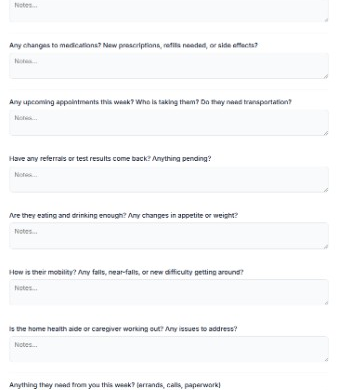
Weekly check-in call template
A structured framework for your regular calls — what to ask, what to write down, and how to keep the conversation productive instead of open-ended.
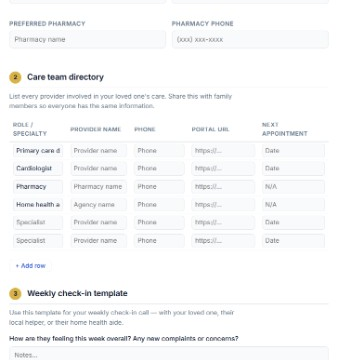
Care team contact directory
One page with every provider, pharmacy, specialist, and aide — names, numbers, roles, and the best way to reach each one. No more searching through old texts.
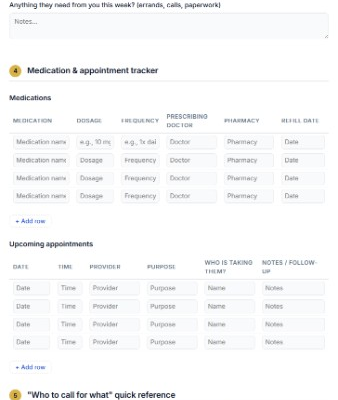
Appointment and referral tracker
Log upcoming and past appointments, track referral status, and note follow-ups so nothing stays invisible between visits.
Medication and pharmacy log
Current medications, dosages, prescribing doctors, pharmacy details, and refill dates — all in one place you can reference during any call.
Family update template
A simple format for sharing weekly updates with siblings and family members — so everyone hears the same version and nobody has to repeat the story four times.
"Who to call for what" quick reference
A decision guide for common situations: who handles prescription refills, who to call about billing, what to do if your parent misses an appointment. One page, no guessing.
Preview: what you'll get
What happens without a system: the quiet drift
It doesn't happen all at once. It's a slow, quiet slide. Nobody drops the ball on purpose — there's just no structure to catch what falls between the calls.
Appointments that nobody mentions. Your parent sees a specialist and you hear about it days later — or not at all. The follow-up instructions sit on a kitchen counter.
Medications changed without telling you. A dosage gets adjusted or a prescription is dropped. You don't find out until something feels off and you start asking questions.
Siblings getting different versions of the story. Your mom tells your brother one thing, your sister another. You're all making decisions from incomplete information — and nobody realizes it until there's a conflict.
Things that are "fine" until they're not. A missed refill. A skipped follow-up. An unanswered referral. Each one is minor on its own — until the day one of them sends your parent back to the ER.
The starter kit gives you a framework so the drift doesn't happen — not because you're doing more, but because what you're already doing has a place to land.
What "organized from afar" actually looks like
Whether you start with the free templates or bring in a Care Continuity Partner, this is where the chaos ends and the clarity begins:
You open one place and see what happened this week — appointments, medications, follow-ups, outcomes. No digging through texts or voicemails.
Next steps are listed. Not vague — specific. Who's doing what, by when, and what's still pending. Nothing is stuck in "we'll call you back."
Your siblings got the same update you did. Same facts, same context, same timeline. No more conflicting versions or secondhand summaries.
Your weekly call with your parent is a conversation — not an interrogation. You already know what happened. You can just be their kid.
It starts with getting organized. The starter kit gives you the framework.
You're already doing the work. Give it a structure.
The starter kit is free, it opens instantly, and it takes about 20 minutes to fill in. The next time something comes up, you'll know exactly where to look and who to call.
Get the free starter kit →Averyn Care provides non-clinical administrative coordination. This starter kit is an informational resource, not medical advice. Consult your healthcare provider for clinical questions.